Thursday, October 7, 2021

What hunters should expect during the 2021 pheasant and quail hunts


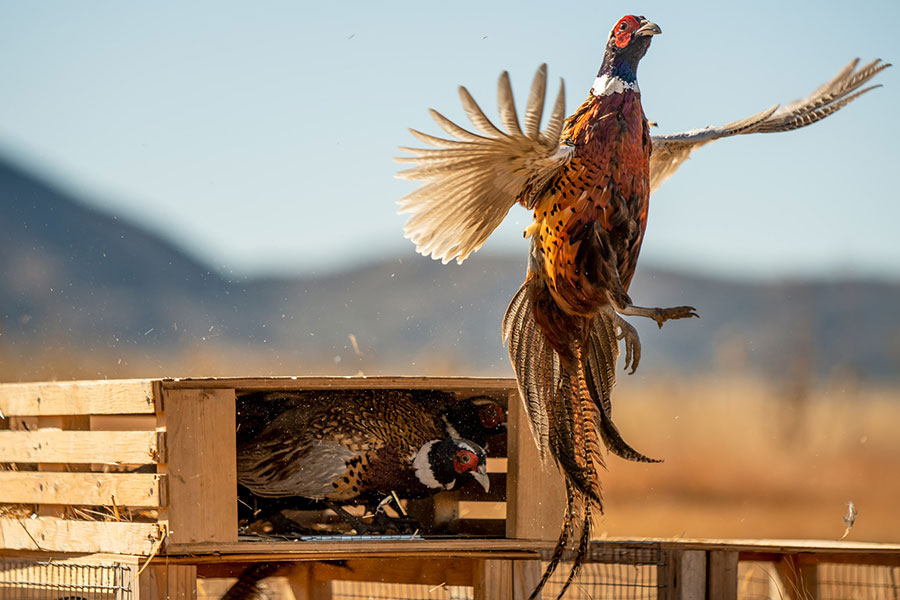
Ring-necked pheasants

SALT LAKE CITY — Many upland game and waterfowl hunts are already underway across Utah. The general-season pheasant and quail hunts open Nov. 6. If you are planning to target either of these birds this fall, here is what you should know.

Pheasant (ring-necked) populations around the state

Utah's general pheasant hunting season runs from Nov. 6 to Dec. 5. The Utah Division of Wildlife Resources releases thousands of pheasants on various wildlife management areas around the state each week during the general-season hunt.

The number of pheasants and where they can be found will depend on where you are hunting in Utah. In northern Utah, there was an average brood production and no major population declines — despite the drought conditions — since the birds were still able to access water in rivers and irrigation canals. Hunting success should be about the same as last year. The majority of pheasants in this region can be located on private land in the eastern portion of Box Elder County. Hunters should remember that written permission from landowners is required to hunt on any private lands.

In northeastern Utah, the drought impacts on pheasant populations were also minimal because their habitat is so closely aligned with irrigated crop lands. Most of the birds in this part of the state are found on private agricultural lands.

Ring-necked pheasants

In central Utah, the highest pheasant populations are found along the south shore of the Great Salt Lake and in agricultural areas near Erda. Pheasants are also released on the wildlife management areas around Utah Lake.

The wild pheasant population is relatively limited in the southeastern part of the state. Due to extreme drought, hunting conditions for wild pheasants will likely be poor this year. Most of the pheasants in this part of the state will be found near irrigated fields on private lands. Popular pheasant hunting areas include the Green River Valley near the town of Green River, the Fremont River near the town of Hanksville, the Miller Creek area of Carbon and Emery counties, and in Huntington, Straight and Ferron canyons.

In southern Utah, hunters can find some wild pheasants in the Monroe and Fish Lake areas of the Sevier Valley. However, there are not a lot of wild populations located in southern Utah, and the severe drought conditions likely reduced the feed and habitat needed for young pheasant survival this year. Hunters should target wildlife management areas where pheasants will be released.

Tips for hunting pheasants

In general, pheasants like areas with nearby fields of wheat or corn that provide feed for them. Pheasants also prefer habitat with stemmed grass that provides nesting cover, as well as areas with dense woods or wetlands with thick cattails that provide shelter during the snowy winter months. These birds are good at hiding in brush, so hunting with a well-trained dog will increase your chances of success.

"If you don't have a dog, you can still be successful by walking slowly to flush out the pheasants," DWR Upland Game Coordinator Heather Talley said. "Many times, they will flush if you stand near them for a few minutes because they think that they've been spotted."

Walking along ditch banks or fence lines is also a good hunting strategy. Pheasants typically prefer to run rather than fly away, so if you walk along these areas, you are more likely to drive them out into the open, where they will flush.

"Hunters should also target the DWR wildlife management areas located throughout the state because we will be releasing about 12,000 pen-reared rooster pheasants in these areas," Talley said. "Birds will be released each week throughout November to help increase hunter success and give everyone a good opportunity to harvest birds this season. If you do choose to hunt on one of our WMAs, be willing to hike a long way away from parking areas and other hunters to increase your chances of finding the wild birds."

Visit the DWR website to see where pheasants will be released throughout the season. (Many of the locations include WMAs and walk-in access areas — which is an area of private land on which the DWR has leased certain hunting, trapping or fishing privileges.) To locate a walk-in access area near you, visit the DWR website.

Hunters should also remember that several of the WMAs require non-toxic shot (for example, steel shot) when hunting. Lead shot may not be used. For more information about the pheasant hunts, visit the DWR website.

Quail (California and Gambel's)

Utah's general quail hunting season runs from Nov. 6 to Dec. 31.

Hunting quail also differs in each area of the state. In northern Utah, the drought didn't have major impacts to the populations, since they primarily stayed in agricultural fields that were irrigated. Hunters should also be able to locate quail near the Great Salt Lake wetlands.

In northeastern Utah, much of the quail habitat is on private land, so make sure to obtain written permission from the landowner prior to hunting. Quail populations in this area weren't impacted by drought since they are mostly located on the irrigated agricultural fields that still had water.

In central Utah, the highest concentrations of California quail are in urban areas, which limits most hunting opportunities. The highest populations of quail are found in and around Tooele City.

Female California quail

California quail

In southeastern Utah, the brood production of California quail was good for the third consecutive year. Quail are not widespread in southeastern Utah, but there are some populations near farmlands along the Colorado and Green rivers, as well as in lower Huntington Canyon and along the Price River.

Gambel's quail numbers decreased in southern Utah (particularly in Washington County) this year, due to drought impacting chick production and the overall population. There are some California quail on the wildlife management areas, but there are fewer birds than last year.

Tips for hunting quail

California and Gambel's quail are hunted using similar methods — just in different habitats. When hunting Gambel's quail, look for Joshua trees, dry washes and draws with black brush or desert almond. California quail will occupy washes containing water and brushy cover, and will eat flowers from grasses, trees and shrubs, as well as seeds and leaves.

"It's best to hunt quail with a trained hunting dog, since quail would rather hunker down and hide than fly away," Talley said. "Holding the quail in place with a dog will enable you to get close enough to flush the birds and get a shot. If you don't have a dog, you can still hunt quail successfully. If you get close enough to running quail before they fly, you can still get a good shot."

Youth hunts

The statewide youth pheasant hunt will take place from Oct. 30 to Nov. 4, and pheasants will be released just before the hunt. The statewide youth quail hunt will take place from Oct. 30 to Nov. 1. If you were 17 years of age or younger on July 31, and you've completed Hunter Education, you can participate in the hunt. If you haven't yet finished Hunter Education — and you're at least 12 years old — you still might be able to participate through Utah's Trial Hunting program. You must also have a hunting license and follow all of the state's upland game hunting rules.

The DWR and several partners will also be hosting several youth and beginner hunts around the state. You can find the details of those events and register for them on the DWR website.

Upland Game Slam

To add an extra challenge to your hunts this fall, consider participating in the Upland Game Slam. Similar to the Utah Cutthroat Slam, it encourages hunters to harvest a variety of upland game species, while generating money to help fund a variety of habitat and upland game-related projects.

Hunters complete a slam by harvesting the required amount of the target species. Each slam is designed to give you an extra challenge while you're hunting, as well as the opportunity to earn a commemorative, collectible coin. The entry fee is $20 for hunters 18 years of age or older, or $10 for hunters 17 years of age or younger. The "Appetizer Slam" includes some of Utah's smaller game birds, including California quail, Gambel's quail and mourning dove. To complete the slam, hunters must harvest one of each of the three species within a single hunting season. Learn more about how to participate in the various Upland Game Slams on the DWR website.

Check the 2021–22 Upland Game and Turkey Guidebook for details on regulations for hunting each species, including the legal weapons for each upland game species.

Wednesday, October 6, 2021

Beautiful UTAH: The wonderfully weird world of mollusks

Fatmuckets in sand 

The wonderfully weird world of mollusks

Discover these fascinating invertebrates in Utah and beyond!

By Kate Holcomb


DWR Native Aquatics Biologist

Statewide Mollusk Specialist

Have you ever heard of animals named creeping ancylid, sub-globose snake pyrg, button sprite or the sluice snaggletooth? What about the fatmucket, narrow pigtoe or gumboot chiton (aka wandering meatloaf)?

These are all mollusks. And yes, most mollusks have highly amusing names. The first list of names includes just a few of the many native snails found in Utah. The fatmucket and narrow pigtoe are freshwater mussels found in rivers of the eastern United States, and the wandering meatloaf is a kind of chiton (a class of marine mollusks) found in the northern Pacific Ocean.

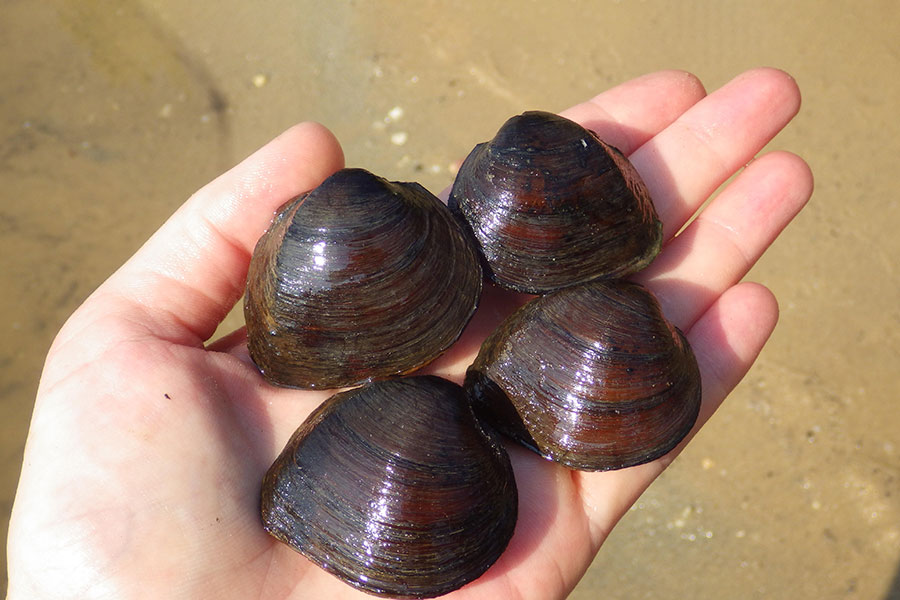
Narrow pigtoes in palm of hand

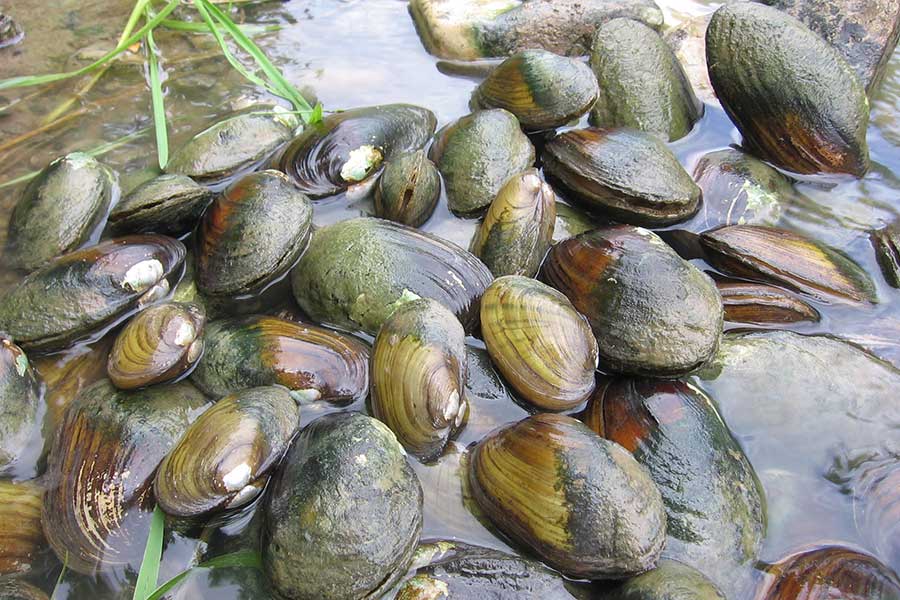
Fatmuckets collected during a stream survey in the Upper Peninsula of Michigan (left) and four narrow pigtoes (right) from a stream in northwest Florida.

The vast diversity of marvelous mollusks

So, what exactly is a mollusk? Elementary school science lessons might be a fuzzy memory for some of us, so here's a quick refresher: mollusks are invertebrates (they lack a backbone) and they make up the second largest group of animals after arthropods (the group of invertebrates that includes insects). There are approximately 85,000 identified species of mollusks alive today, but there are many new species being discovered all the time.

It's difficult to say what a typical mollusk looks like because this group of animals is so diverse. Commonly known mollusks include clams, octopi, squids, snails and slugs. Mollusks can be found in marine, freshwater and terrestrial (living predominantly or entirely on land) environments.

Along with their weird names, mollusks are also weirdly and wonderfully interesting animals. Many people have gone beachcombing at the ocean and are familiar with the wide variety of shapes, sizes, colors and textures of mollusk shells — the "bones" of dead mollusks — but fewer people have had the opportunity to explore the world of living mollusks.

DWR biologists surveying for mussels

DWR biologists surveying for mussels and other aquatic animals in a Utah freshwater stream.

The oceans are full of fascinating mollusks. Search online for "nudibranchs" and you will quickly see what I mean! Nudibranchs (a type of sea slug) have no shell for protection, but they use striking colors, patterns and body projections to send a message to predators that they are not worth eating.

Another group of sea slugs, the sacoglossans (solar-powered sea slugs), are able to produce their own energy like plants. Sacoglossans do this by eating algae and keeping chloroplasts (plant cells that photosynthesize) in their body, and it's very rare for animals to be able to do this. Cephalopods — octopus, cuttlefish and squid — are among the most intelligent invertebrates on Earth. If you have seen the movie "My Octopus Teacher," you are likely familiar with how smart they are.

And the gumboot chiton is just plain weird, but it is playing an important role in the field of biomimetics. (That's the science of mimicking nature to develop new technologies, such as how the tiny hooks on plant burs — the plant seeds that stick to your socks — inspired the invention of Velcro.) Scientists have been studying the chemical makeup of the gumboot chiton's teeth to help design robot parts that are hard and strong in some places and soft and flexible in others.

Taking a closer look at Utah's amazing mollusks

Despite being one of the driest states in the nation, Utah is home to a surprising diversity of mollusks. We have two native freshwater mussel species, 13 pea clam species, 57 aquatic snail species and 61 terrestrial snail species. The freshwater mussels and many of the snails can be found in surrounding states as well. However, some of our springsnails (tiny snails that tend to live in springs) are only found in one spring in Utah and nowhere else in the world.

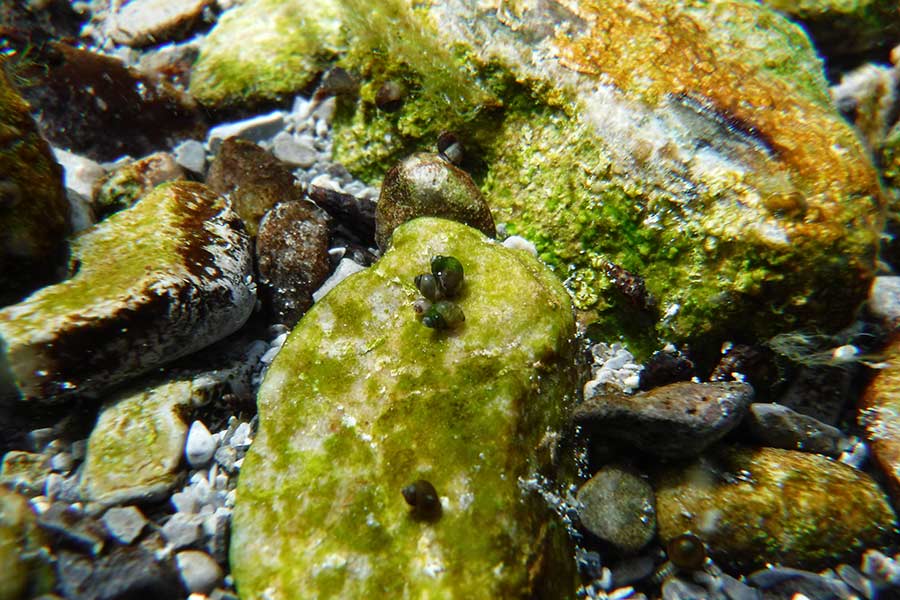
Snails on a rock

Can you find the five small springsnails on the rock in the center of the photograph? These springsnails were found at the Fish Springs National Wildlife Refuge.

Our Utah mollusks may not be as showy as their marine relatives, but they are an important part of healthy ecosystems (unlike invasive quagga mussels and Asian clams).

Utah's mollusks are like nature's janitors and help keep the environment clean. Freshwater mussels suck water in through their siphons and filter the water through their gills to collect tiny food particles and bacteria. This filtering process helps keep the water clean and clear for us and other animals.

Snails in aquatic and terrestrial environments eat living and dead plant material and help prevent excessive vegetative build up. Snails and freshwater mussels also aid nutrient cycling in the environment and are an important food source for many animals.

If I have not already grabbed your attention, I will leave you with an introduction to the intriguing life cycle of the freshwater mussel. This animal's unusual adaptation is what got me hooked on mollusks when I was in college, and I have been fascinated ever since.

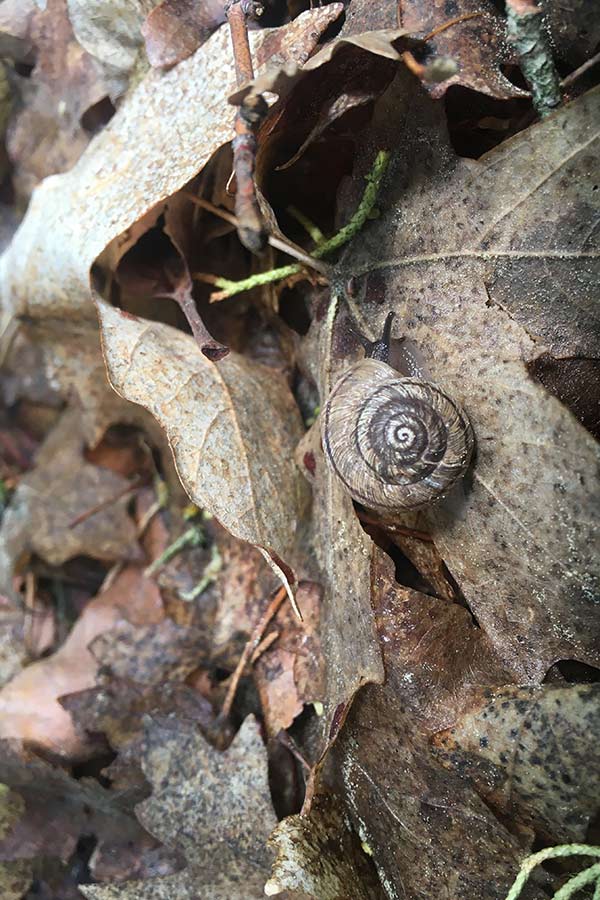
Snail crawling on leaves

A mountainsnail feeding after a light rain. Kate found this mountainsnail in Millcreek Canyon near Salt Lake City, UT.

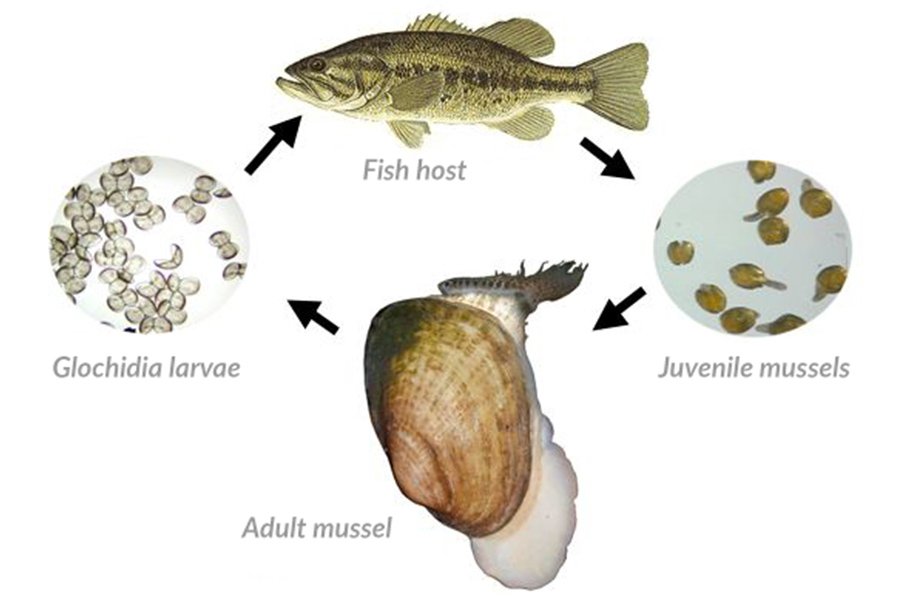
Freshwater mussels are unique in that they require a host fish to complete their life cycle. The life cycle begins when the male and female mussels spawn, and then the female mussel broods fertilized eggs in her marsupial gills.

While the eggs mature into larval mussels (called glochidia) in the safety of their mother's gills, the mother mussel is devising a strategy to attract the right host fish. Some mussels can only use certain fish hosts — not just any fish will do. If a mussel species uses a predatory fish as a host (like a bass), the female mussels will often make a lure from their own flesh that imitates the color patterns and movements of a prey fish.

When a predatory fish is fooled by a mother mussel's lure and tries to eat it, the mussel releases her glochidia toward the fish so that the glochidia can attach to the fish's gills. If the glochidia reach the gills of the appropriate host fish, they will hook on to the gills for a few weeks and use the nutrients from the fish's gills to grow and metamorphose into a juvenile mussel.

This process is not intended to harm the host fish — the glochidia need their host to be healthy if they are to survive! Once a glochidia has metamorphosed into a juvenile mussel, it drops off the fish, settles into the sand at the bottom of a lake or stream and begins its life as a freshwater mussel. Check out this video to see how this fascinating process works.

Snail crawling on leaves

The freshwater mussel life cycle.

Photo Credit: Chris Barnhart and Joe Tomelleri, Freshwater Mollusk Conservation Society

Some details about the life cycle of our freshwater mussels in Utah are still not fully understood. The winged floater likely uses a wide range of fish species as hosts. Floaters broadcast their glochidia in the water, and the glochidia's hooks and sticky threads help them successfully attach to a host fish (see this cool video for an example of what this looks like).

Check out this amazing video shared by DWR biologists! A speckled dace (a Utah native fish) tries to eat a conglutinate from a western pearlshell in a Utah stream.

Western pearlshells from other nearby states use salmon and trout as host fish, and they use conglutinates (tiny packages of glochidia) to transfer glochidia to the host fish. Mussels often create conglutinates that mimic a fish food item — like an aquatic insect — so fish will try to eat the conglutinate. As soon as the conglutinate is in a fish's mouth, it will explode like a bomb, and the glochidia will then have easy access to the fish's gills.

The freshwater mussel life cycle is weird, yet truly amazing. How do freshwater mussels make lures that are so lifelike and effective? They do not have eyes or a brain, so lots of time and trial and error have helped freshwater mussels hone in on creating the perfect lures. I encourage you to take some time to nerd out on freshwater mussel lure videos online — I bet you can't watch just one video!


In This Week's Edition: October 6, 2021


#inthisweeksedition #paysonchronicle #thepaysonchronicle #readthepaysonchronicle 

Monday, October 4, 2021

THE SHIFTING LANDSCAPE


The Olson brothers (front row, left-right) Myron, Bill, (back row, left-right) Douglas, and Bob posed for this photograph in the early to mid-1950s in Santaquin.  This was a more agrarian time in the small town and city’s brief history.

They were farm boys raised by dad and mom, Vivan and Ada York Olson in a simple home on the corner of 2nd East and 1st South, across the street--east--from The Church of Jesus Christ of Latter-day Saints chapel at 90 South 200 East.  This home still exists.

After World War II, the newly married Myron and Ethel Olson built their home in central-eastern Santaquin.  Macey’s grocery store parking lot lay here today.

The couple’s address in later years was listed as on East Orchard Lane.  However, this stretch of road had served as an extension of Highway 6 while they raised their five children, Mike, Karen, Deanne, Dan, and Scott and tended the family farm that surrounded them.

Based on the mountain’s position in the background, this photograph was taken in an area located between Vivan and Ada’s place and Myron and Ethel’s home along the old highway.  This mountain would later play prominently in Myron Olson’s book, Give Me This Mountain: A History of the Santaquin Utah Stake, published in 1984.


#shiftinglandscapes #theshiftinglandscape #paysonchronicle #thepaysonchronicle #readthepaysonchronicle #centralutah #utahcounty #santaquin #givemethismountain #1984


Friday, October 1, 2021

Scavenger Hunt Clue B 1449


A clue for you. (If you are taking part in the Payson Santaquin Area Chamber of Commerce Halloween Scavenger Hunt, you should know what to do.)


Anglers Encouraged To Catch Trout At Payson Lake Prior To October 12 Drainage


The Utah Division of Wildlife Resources is encouraging anglers to fish at Payson Lake before it is drained next week.

“Payson Lake will be completely drained for dam repair work,” DWR officials reported on Friday.  They will begin draining the lake in Payson Canyon starting October 12.


“We increased the daily limit at this lake back in July — to eight trout per day — because of drought conditions,” they said. “Now is a great time to go catch trout at Payson Lake and take them home for dinner!”

Animal Symbolism Show Coming to Peteetneet Art Gallery


Have you ever wondered why there are so many colors of dragons? Or what cougars represent to Native Americans?


Discover the myths, legends and symbolic meanings about creatures across time and cultures through art in this one of a kind exhibit featuring local Utah artists Jess, Beverly, and Julia Hansen.


Julia Hansen: A Walk on the Wild Side 

Artist Julia Hansen’s passion is to accurately portray the individual personalities of animals and loves illustrating exotic creatures. She has been doing fine art for over fifteen years and has endeavored to perfect the technique of creating realism using pastels and oil painting. The fur, poses, and kinds of animals she depicts make one want to reach out and touch them. 


She has since won a variety of awards including the Juror’s Choice Award in 2011 Utah Hogle Zoo World of the Wild Art Show. She graduated Spring 2020 with a master’s degree from Johns Hopkins University in Museum Studies with an added Digital Curation certificate, and works as an independent curator to help others understand the significance of cultures, art, animals, and history.


Julia Hansen Website: https://www.deviantart.com/egyptsdragoneyes 

Instagram: @egyptsdragoneyes https://www.instagram.com/egyptsdragoneyes


Jess Hansen: Unleashed Beauty 

Jess Hansen believes that all emotions can be expressed through the creatures of this earth, and her art captures the souls of the animals she depicts. Jess graduated from the Art Instruction School in Minneapolis, MN in April 2011. Since then she has won a number of awards for her wildlife art in pastel, ink, oil painting, and digital artwork. This includes a number of other awards in the professional division at the Utah State Fair, Juror’s Choice Award at the 2011 Utah Hogle Zoo World of the Wild Art show in Salt Lake City, and Best of Show for one of her digital pieces at the 2017 Anime Banzai. 


Jess completed undergraduate classes at Utah Valley University and the University of Utah. Her work was published in the 2010 and 2017 Illustrator Magazine. She is a member of the internationally acclaimed artists group called Artists for Conservation and the Pastel Society of America.


Jess Hansen Website: imaginemyuniverse.com 

Instagram: @imaginemyuniverse https://www.instagram.com/imaginemyuniverse

Facebook: https://www.facebook.com/imaginemyuniverse 


Beverly Hansen: Where the Wild Things Are 

Artist Beverly Hansen loves the beauties of nature and the animals which are part of our world. When one stares at a blank canvas and then uses their creativity to create something that didn’t exist before one begins to realize how imagination is truly an amazing process. Beverly endeavors to spread beauty and creativity throughout the world through her talents in art, music, and sewing.


Beverly started her arts career with a Bachelor’s Degree in Arts with an emphasis on violin pedagogy. She expanded into other artistic endeavors over the years including oil painting and pastels.  Beverly has won a number of awards for her pastel art in the Professional division at the Utah State Fair, Utah Hogle Zoo World of the Wild and most recently 1st place in 2020 at the Utah Valley Artist Guild Scera Art Show.


Beverly Hansen Instagram: @bbemerald https://www.instagram.com/bbemerald


Location

Peteetneet Museum and Cultural Arts Center

Art Gallery

10 North Peteetneet Blvd.

Payson, UT 84651 


Exhibit Dates

October 12 – December 14, 2021

Monday – Friday, 10 a.m. - 7p.m.

Closed Saturday and Sunday


The Payson Chronicle

Election Information — 2026